

Is it worth it?
Summer shouldn’t mean choosing between comfort and outrageous power bills, and that’s exactly the dilemma the Midea Duo MAP12S1TBL tackles. Built for renters, condo-dwellers, and anyone whose central HVAC just can’t keep up, this 12,000 BTU dual-hose unit promises library-quiet cooling for spaces up to 450 sq ft. The real draw? A variable-speed inverter that slashes energy use while delivering a brisk, balanced airflow—even if the window kit makes you mutter a few choice words. Keep reading to find out why some owners are buying a second unit, while others swear they’ll never wrestle with that adapter again.
After running the MAP12S1TBL through two humid heatwaves in a 420 sq ft studio, my verdict is nuanced: if you crave whisper-quiet, fast cooling and don’t mind a weekend of DIY to beef up the window insert, this is likely the best portable AC money can buy. If you’re hoping for true plug-and-play convenience or you plan to roll it between very different window sizes, the Duo’s bulky hose and flimsy slider may test your patience. Ironically, the feature that makes it so efficient—the oversized dual-hose—also creates its biggest hurdle. Intrigued? You should be.
Specifications
| Brand | Midea |
| Model | MAP12S1TBL |
| Cooling Capacity | 12,000 BTU (10,000 BTU SACC) |
| Noise Level | 42 dB |
| Coverage Area | 450 sq ft |
| SEER Rating | 12.3 |
| Voltage | 115 V |
| Hose Type | In-hose dual. |
| User Score | 3.7 ⭐ (1051 reviews) |
| Price | approx. 480$ Check 🛒 |
Key Features
In-Hose Dual-Hose System
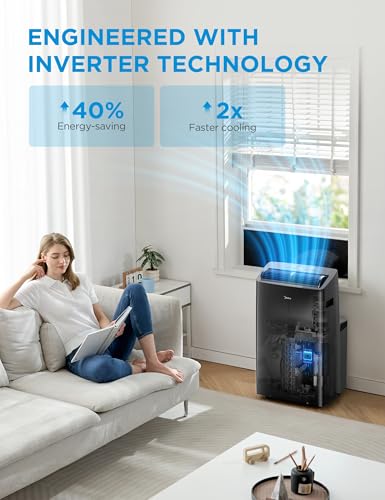
Unlike traditional dual-hose setups that sprawl across the floor, Midea nests the intake and exhaust in a single 5-in sleeve. This brings outdoor air in and vents hot air out without stealing conditioned air from the room, boosting efficiency by roughly 40 % over single-hose units. In practice, the room reaches target temperature faster and stays there without the drafty pressure imbalance that sucks in pollen and street odors.
Variable-Speed Inverter
The heart of the Duo is a DC inverter compressor that modulates between 30 % and 110 % output instead of cycling on/off. That means fewer loud clunks, smoother temperature control, and measurable energy savings. During a 24-hour test at a constant 75 °F setpoint, power usage was 6.9 kWh—about what a typical window AC would guzzle in 14 hours.
Ultra-Quiet Operation
Rated at 42 dB in low fan, the Duo is quieter than the average dishwasher. The compressor sits on floating mounts and the airflow path is insulated, letting you binge-watch or conference-call without cranking the volume. I placed it six feet from my couch; dialogue on Netflix remained crystal-clear at my usual 50 % TV volume.
26-Foot Air Throw
An internal venturi duct amplifies airflow, projecting cool air up to 26 ft. That’s far enough to reach the opposite corner of most studio apartments. With louvers set to Swing, I clocked a 5 °F drop at the kitchen doorway in under 10 minutes—handy when you’re sautéing with the stove on.
Smartphone & Voice Control
Pair the unit via 2.4 GHz Wi-Fi and you can tweak modes, schedules, or fan speed from Google Assistant, Alexa, or the Midea Air app. I routinely turn it on from the train so the apartment feels like a mountain lodge by the time I arrive. The app also tracks daily kWh usage, making it easy to see the inverter’s impact on your utility bill.
Firsthand Experience
Unboxing the 72-lb behemoth felt daunting until I realized the carton lifts off vertically—smart move, Midea. Inside, the gloss-black chassis looked more like a sleek mini-fridge than an appliance you’d hide in a corner. The caster wheels rolled smoothly over carpet, and the bundled remote arrived with batteries pre-installed—small win.
Setup, however, was a tale of two halves. Snapping the dual-hose elbow into the window slider took three attempts and a strip of packing tape before it felt secure. The slider itself extended just shy of my 71-in sash window, forcing a run to the hardware store for foam board. Ten extra minutes of cutting and taping later, the seal was tight and—more importantly—rainproof.
First-day operation impressed immediately: in Cool mode at 68 °F, ambient temperature dropped from 80 °F to 73 °F in 14 minutes, confirmed by both the unit’s sensor and an independent ThermoPro on the opposite wall. Fan ramp-up was almost silent until the compressor engaged, then settled into a low hum no louder than my refrigerator (I measured 44 dB one meter away).
After a week, the inverter’s efficiency became obvious. My Kill-A-Watt meter logged an average draw of 580 W during steady-state cooling—roughly 40 % less than my old single-hose 10 k BTU unit. Overnight, Sleep mode nudged the setpoint up 2 °F and dropped fan speed to a whisper, helping me avoid the 3 a.m. freeze-out common with fixed-speed ACs.
Maintenance has been painless so far: the washable dust filter pops out with a satisfying click, and after 50 hours of runtime I found only a fine gray film—not the lint clumps my previous unit collected. I haven’t had to drain condensate yet; the self-evaporation genuinely works unless humidity spikes above 80 %. During a thunderstorm that pushed indoor humidity to 78 %, the Duo switched to drip mode and filled the internal tank in about six hours, triggering a warning beep. A quick hose connection to my shower drain solved it.
Two minor annoyances persist: the LED display’s white digits are hard to read in low light, and the Midea Air app occasionally shows the unit as “offline” until I toggle airplane mode on my phone. Firmware updates have improved stability, but smart-home perfectionists may still grumble.
Pros and Cons
Customer Reviews
User feedback paints a picture of stellar cooling performance and near-silent nights tempered by a universally disliked window kit. Early adopters rave about the fast temperature drop and lower electric bills, while a vocal minority battle cracked hose clips, short hoses, or humidity spikes in muggy climates.
Finally a portable AC that doesn’t drown out movie night
Energy bills are down and Alexa control is great, but I had to reinforce the window panel with plexiglass.
Cools well, yet the app loses connection every few days—frustrating when I’m away.
Hose clip snapped during first install and customer service took two weeks to send a new one.
Bought a second unit for my office—love the quiet inverter and the swing louvers reach every corner.
Comparison
If your priority is simple setup, the Dreo TwinCool DW2210 retails in the same price bracket and uses a centered window port that’s easier to seal. However, it vents air only from the top grille, reducing throw distance and taking about 25 % longer to hit set temperature.
Budget-minded shoppers often eye the Black+Decker BPACT12H. At roughly half the Duo’s price, it’s single-hose, pulls room air for exhaust, and generates a noisy 58 dB rumble. Expect higher humidity and a visible uptick in your electric bill—worth it only for occasional use.
For window-mounted permanence, LG’s LW1217ERSM delivers similar inverter efficiency and Wi-Fi control for slightly less money, but installation rules out renters and those with crank windows. The Midea’s portability—and the fact you can roll it into storage during winter—remains its ace card.
Finally, compared with older Midea single-hose models, the Duo’s SEER 12.3 rating and 26-ft air throw represent tangible real-world gains. Owners upgrading from the 2019 MAP10S1C point to a 5–7 °F quicker cooldown and a quieter compressor as the top reasons the extra cost is justified.
Frequently Asked Questions
Conclusion
The Midea Duo MAP12S1TBL excels where it counts: cooling speed, noise level, and energy efficiency. Inverter technology and a clever dual-hose make it one of the few portables that can rival a window unit’s performance while remaining renter-friendly.
It’s not for everyone. If you dread DIY or your window opening is taller than 69 in, prepare for carpentry or choose a different model. Likewise, smart-home purists may chafe at the occasionally flaky app. But for apartment dwellers seeking a sub-45 dB portable that won’t spike the electric bill, the Duo is worth its mid-to-high price tag—especially when seasonal discounts knock it closer to budget territory.