Key features
Sleep-ready controls
This fan is built around overnight comfort, not just raw airflow. The 28 dB noise claim, 12-hour timer, and Advanced Sleep mode all point in the same direction: less noise, less light, and less need to get up once you are in bed.
That matters because bedroom fans fail as often from small annoyances as from weak airflow. If you are sensitive to bright displays or control beeps, this model is much easier to place beside a bed than a basic tower fan with a permanently lit panel.
Wide airflow in a slim body
The combination of 90° oscillation, 25 ft/s velocity, and 1044 CFM gives this fan a broader room role than a bedside personal fan. It is still a fan-only product, but it is designed to spread moving air across more of the room rather than aiming at one chair.
The practical implication is simple: in a bedroom, office, or small shared room, it can cover more than one spot without dominating floor space. If your goal is whole-room temperature reduction, though, this is the wrong tool for the job.
Auto and Turbo modes with a temperature sensor
The useful part of the mode selection is not the number itself but what it changes in daily use. Turbo mode starts with maximum airflow and oscillation for quick circulation, while Auto mode adjusts fan speed based on room temperature.
That gives the fan a more hands-off rhythm than a basic on-off tower fan. It is convenient if you want to cool down quickly and then let the fan back off on its own, but people who want completely fixed behavior may prefer to stay in Normal mode.
Remote-first convenience
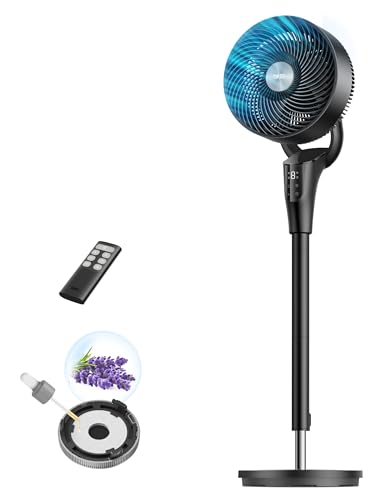
A tower fan earns its keep when you can change it from where you are sitting or lying down, and this one includes a remote alongside touch controls. In real use, that makes timer changes, sleep mode, and oscillation far more practical.
The caveat is that this is a remote-centric design. If you are the type who misplaces small accessories, that can become more annoying here than with a simpler fan that is equally easy to control from the top panel.