

DR.PREPARE DCCF10
Remote, timer, and 8 speeds add real day-to-day convenience. Bright display and close-range operation may bother light sleepers if placed too near the bed.
Read reviewBest overall: DR.PREPARE DCCF10. We compared 4 fans and Evaporative Coolers using current price, editorial assessment, and buyer feedback.
The ranking weighs current price, editorial assessment, useful technical data, and buyer feedback.
Remote, timer, and 8 speeds add real day-to-day convenience. Bright display and close-range operation may bother light sleepers if placed too near the bed.
Read review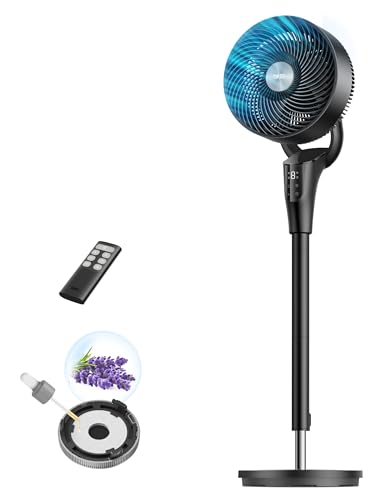
Remote control and top-panel controls make daily use easy Manual vertical tilt is less convenient than remote-controlled multi-axis adjustment
Read review| DR.PREPARE DCCF10 | 25 dB | 6.2"D x 6.2"W x 16"H | 8.6 | 7.4 | $35.69 |
| DREO DR-HPF013 | 20 dB | 11.02"D x 11.02"W x 42.13"H | 9.1 | 7.0 | $69.93 |
| DREO Tower Fan | 28 dB | 8.03"D x 8.03"W x 36.26"H | 8.8 | 7.1 | $54.99 |
| LEVOIT LTF-F361-WUS White | 28 dB | 6.5"D x 6.5"W x 36.2"H | 8.8 | 7.1 | $54.95 |
This is a strong fit for someone who wants a small, quiet bedroom or desk fan with real convenience features, not a pretend air conditioner. The appeal is the compact 6.2 x 6.2 x 16 inch footprint, the 8-speed DC motor, and the remote, all wrapped in a design that aims at close-range comfort rather than brute-force room cooling. The trade-off is simple: you get a lot of control and a sleep-friendly profile, but not the kind of long-throw airflow that replaces a larger tower or a true AC unit.
The DREO DR-HPF013 is aimed at anyone who wants stronger bedroom or small-room airflow than a basic box fan or cheap pedestal fan, without living with constant motor noise. Its appeal is easy to understand: DC-motor quiet, broad oscillation, remote control, and enough airflow on paper to work beyond arm’s length. The clearest trade-off is height. This is a compact pedestal fan with a 38-42 inch range, so it fits bedsides and living rooms well, but it is not the right pick if you want a tall fan throwing air down from above.

The DREO Tower Fan is aimed at the shopper who wants better bedroom comfort without dragging in a bulky box fan or paying for a more feature-heavy premium tower model. Its strongest case is simple: a slim 36-inch fan with 90° oscillation, four speeds, three modes, an 8-hour timer, and a remote, all wrapped around a sleep-friendly pitch of low noise and easy room placement. The real trade-off is that this is a fan, not an air conditioner, so the win here is strong airflow and better circulation rather than true room-temperature drop.

The LEVOIT LTF-F361-WUS White is aimed at the person who wants bedroom-friendly airflow without dragging out a bulky box fan or expecting portable-AC style cooling. Its strongest case is simple: a slim 36-inch tower format, 90° oscillation, a claimed 28 dB quiet mode, and sleep-focused controls that make it easier to live with overnight. The real trade-off is that this is still a fan, not a room-cooling machine, so it works best as airflow relief rather than a substitute for air conditioning in a hot, humid space.
The ranking compares published products with a stable framework: editorial quality, buyer signals, current price when the preset requires it, and comparable category metrics. It does not claim original lab testing; it documents how available signals are weighted so the order remains auditable.
Setup: Collect published reviews, current product data, and comparable technical fields.
Measured variable: Coverage for current price, rating, local review URL, and primary category metrics.
Evaluation rule: Only updated products with enough comparable data can enter.
Setup: Cross editorial score, buyer signals, and price when the preset requires it.
Measured variable: Normalized ranking score on a traceable 0-100 scale.
Evaluation rule: The winner must sustain a stronger balance than the finalists, not just one isolated metric.
This ranking is refreshed from published reviews, current category catalog signals, editorial scoring, and current price. Scores are calculated against the eligible category universe; the visible top only shows the models that pass the final cut.
Descending order: the winner has the strongest balance of Q_final and normalized price against the eligible category universe.
Buyer signal uses the scoring v2 Bayesian score; it is not a simple stars times two conversion.
Computed against eligible comparable category candidates, not only against the visible top. P05=38.579; P95=67.689.
If a critical axis falls below the threshold, final quality is penalized so one weak product cannot win only on price.
It does not mean choosing the cheapest product by default. The ranking crosses editorial score, buyer satisfaction, useful technical data, and updated price to identify the model with the most defensible balance.
The page prints the latest available refreshed price to make comparison clearer, but Amazon can change price and availability at any time. The live purchase link remains the final check before buying.
Yes. The preset ranking keeps the editorial frame, URL, and components stable while recalculating internal positions when comparable data changes or new models enter the catalogue.
The ranking is not meant to list the whole catalogue. A model first needs a published review, a current price, and comparable signals; then only the set that clears the operational cut is ordered. A product can stay outside the visible top when its price is stale, it has no public URL, its useful data is incomplete, or its balance of quality, user signal, and price remains weaker. This keeps the same freshness gate used across the rest of the site.